Happiness , Equality, and Social Democracy
What is Happiness in Canada?
Many people think of happiness as a positive emotional state, associated with smiling, laughing, and feeling good (e.g., I feel happy today). However, people often use happiness to describe their assessments and judgements too (e.g., I’m happy with my life overall). We care about both of these aspects, but we usually talk about them using the following scientific terms.
Wellbeing: Wellbeing is your inner subjective state; the quality of your life as you experience it. We believe that the ultimate good is the wellbeing of present and future generations. Other goods (like health, wealth, relationships etc.) are good because they help us to feel good.
Subjective wellbeing: When a person is asked to represent their feelings with a number, they are being asked to rate their subjective wellbeing. The only way to know how someone is feeling is to ask them but there are many ways to do this, as we explain below.
Life evaluation: One method asks people to provide a reflective assessment of their life overall. Our happiness ranking is based on a life evaluation question derived from the Cantril Self-Anchoring Striving Scale (Cantril Ladder). It asks people to rate their life on a 0-10 scale, from the worst possible life (0) to the best possible life (10).
Life satisfaction: Like the Cantril Ladder, life satisfaction is a specific type of life evaluation question. A common question is: Overall, how satisfied are you with your life nowadays?, from not at all (0) to completely (10).
Affect: Another method is to focus on a person’s feelings or emotional states, usually at a particular point in time, and divided into two opposing categories: positive affect (e.g., laughter, enjoyment, interest) and negative affect (e.g., worry, sadness, anger). A common question is: Did you experience (enjoyment, worry etc.) during a lot of the day yesterday? (Yes/No).
. -World Happiness Report

HAPPINESS is Political!
EQUALITY is a Right!
SOCIAL DEMOCRACY
is the way!
The World Happiness Report is the world’s foremost publication on global wellbeing and how to improve it.
"Our global happiness ranking is based on a single question from the Gallup World Poll, derived from the Cantril Self-Anchoring Striving Scale:
Please imagine a ladder with steps numbered from 0 at the bottom to 10 at the top. The top of the ladder represents the best possible life for you and the bottom of the ladder represents the worst possible life for you. On which step of the ladder would you say you personally feel you stand at this time?"
2025 World Happiness Report Rankings before tax
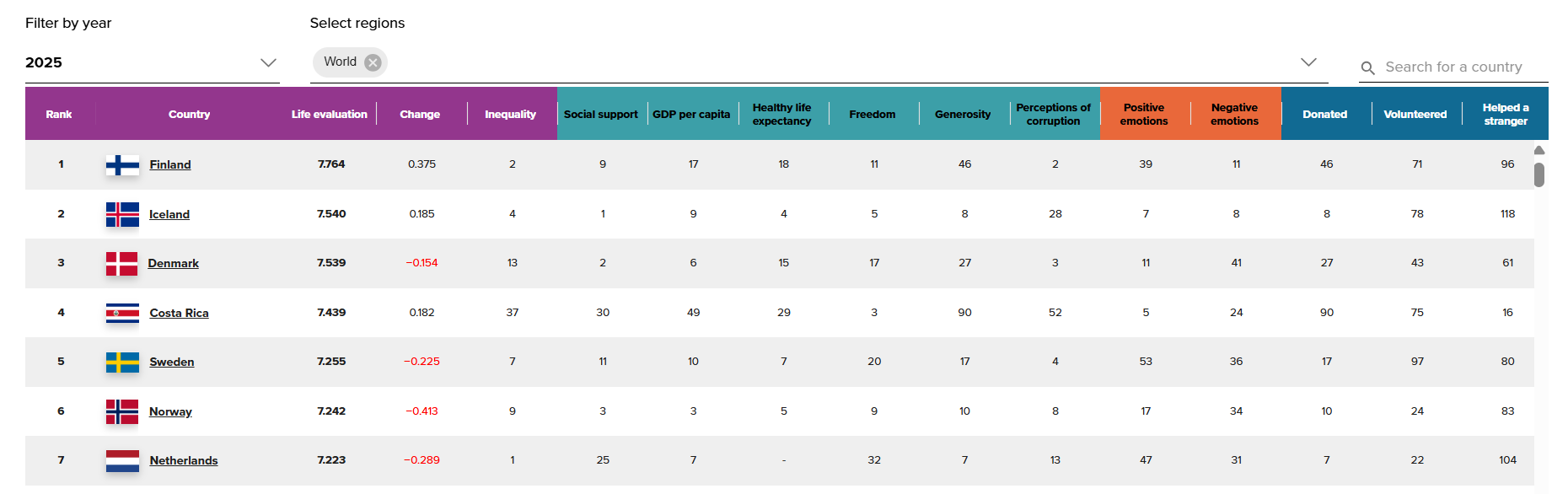
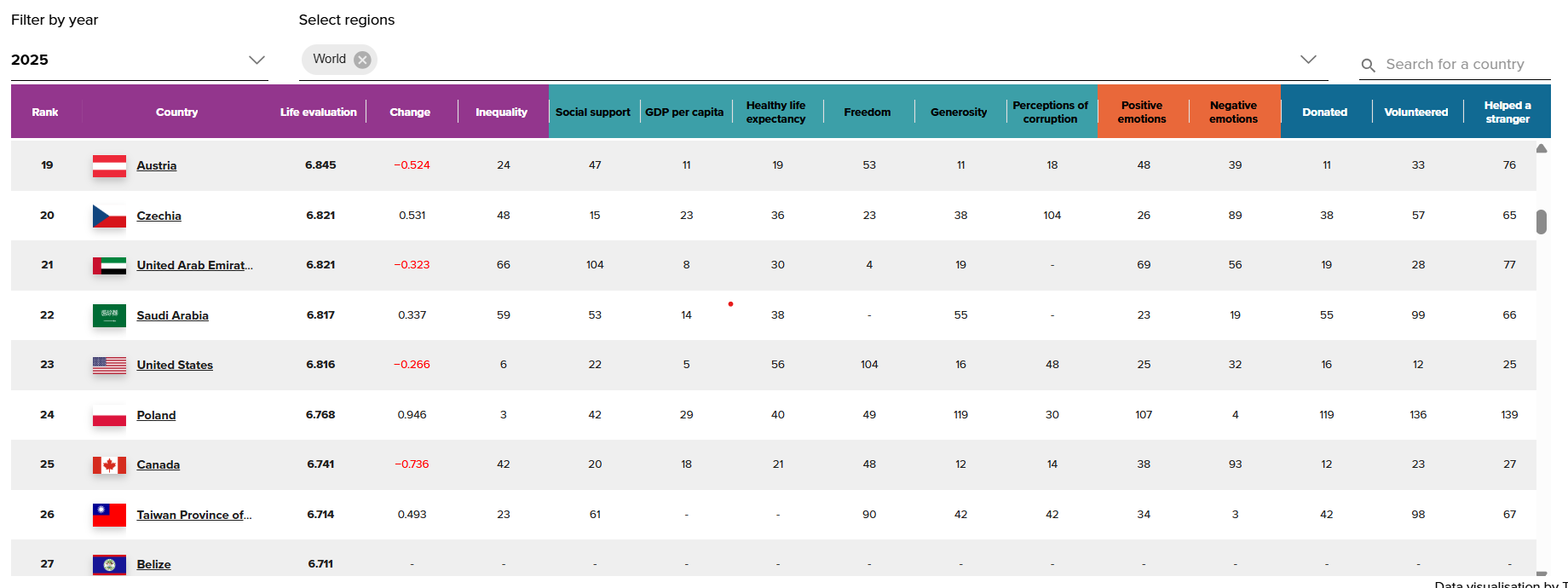
Many of the top-ranking nations are widely recognized for following social democratic models (characterized by strong social welfare systems, high levels of social support, and public services).
Top-ranked countries often combine strong social support systems with other factors like higher income levels and personal freedom .
Within these lists, the countries traditionally associated with social democratic or Nordic models include: Finland, Denmark, Iceland, Sweden, Norway, Netherlands.
What is Equality in Canada?
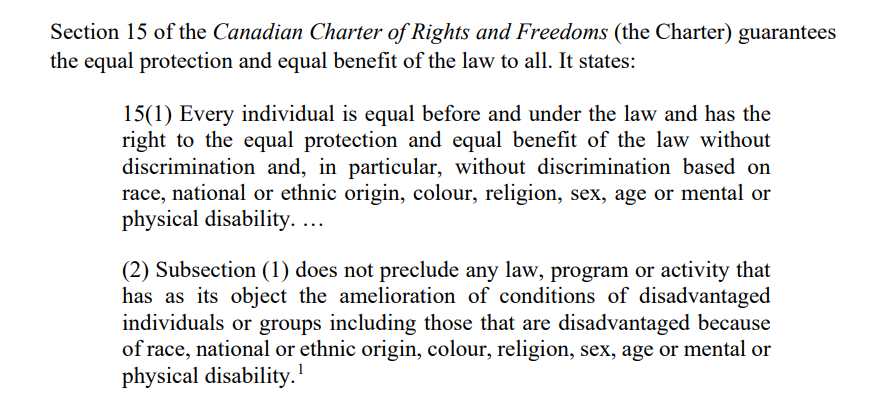
Equality is defined as the right of every individual to be treated equally before and under the law, without discrimination based on race, national or ethnic origin, colour, religion, sex, age, or mental or physical disability. This principle is enshrined in Section 15 of the Canadian Charter of Rights and Freedoms.
What about our socioeconomic rights? Do Canadians have economic equality?
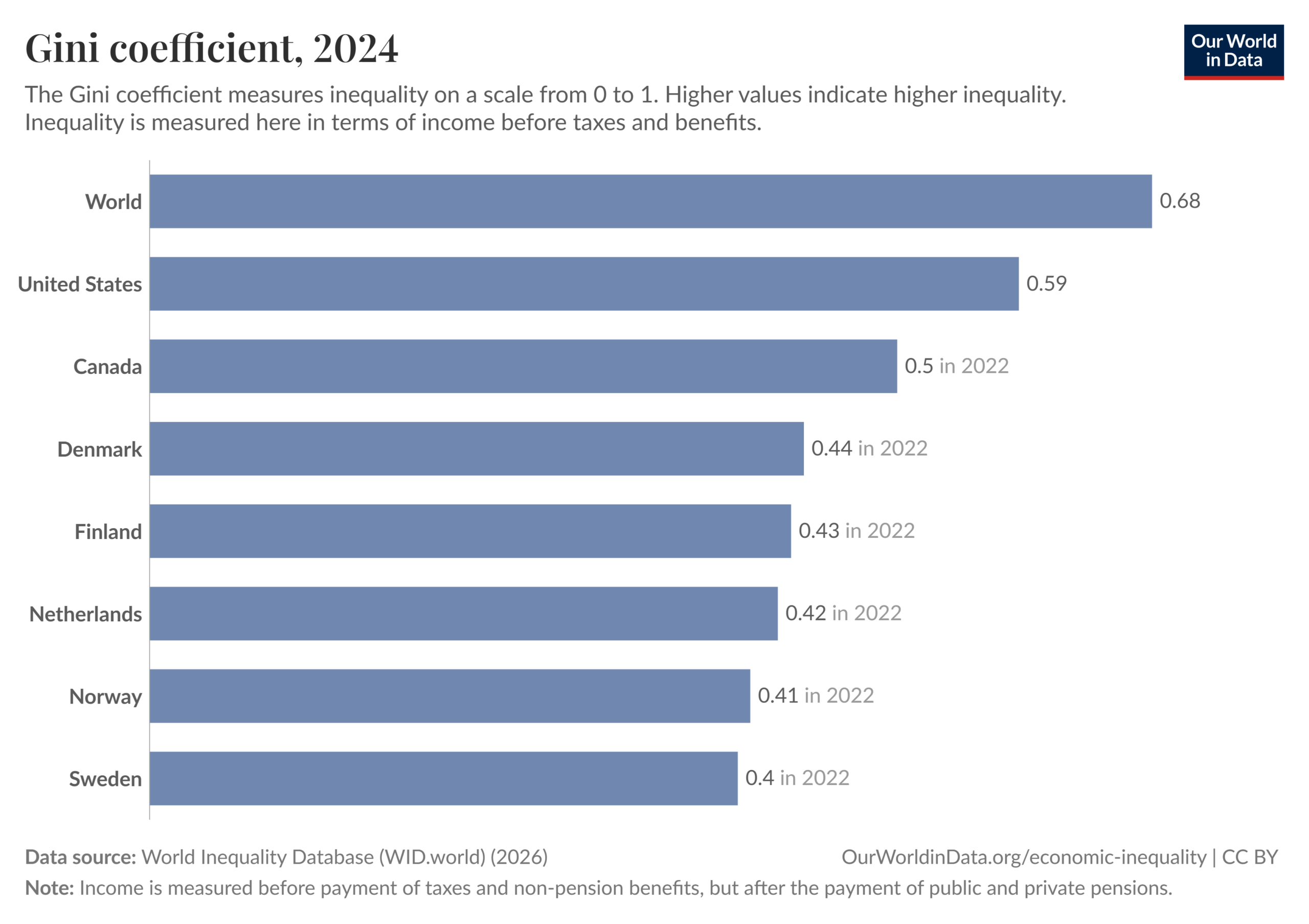
Apparently, One of the five major and common concern of most governments is the equitable (fair) distribution of income, which is a crucial element of a functioning democratic society. With regard to this macroeconomic goal, the distribution of income or wealth in an economy is represented by a Gini Coefficient and Lorenz Curve.
Income inequality is the difference in how income is distributed among the population.
Income is defined as household disposable income in a particular year. It consists of earnings, self-employment and capital income and public cash transfers however, income taxes and social security contributions paid by households are deducted. Inequality is also described as the gap between rich and poor, income inequality, wealth disparity, wealth and income differences, or the wealth gap.
These statistics and history shows us that social democracy and equality are two sides of the same coin, social democracy is the path.
What is a Democracy?
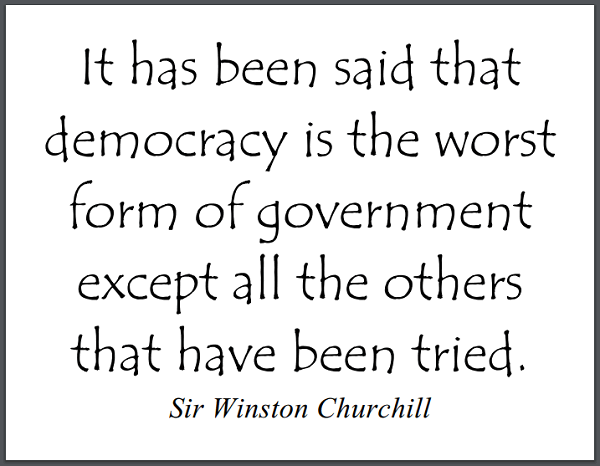
Democracy is a system of government in which laws, policies, leadership, and major undertakings of a state or other polity are directly or indirectly decided by the “people,” a group historically constituted by only a minority of the population (e.g., all free adult males in ancient Athens or all sufficiently propertied adult males in 19th-century Britain) but generally understood since the mid-20th century to include all (or nearly all) adult citizens.
Social Democracy- political ideaology that originally advocated a peaceful evolutionary transition of society from capitalism to socialism using established political processes. (Britannica)
How is social democracy different from other types of democracy?
Social democracy is a political ideology that advocates for a peaceful transition from capitalism to socialism using established political processes. It differs from other types of democracy through its emphasis on state regulation, rather than state ownership, of the means of production and extensive social welfare programs. Social democracy also distinguishes itself from democratic socialism which prioritizes the abolishment of capitalism through a decentralized socialist economy. While sharing ideological roots with communism, social democracy rejects its militancy and totalitarianism. It opposes the Marxist view of democracy as a facade and proclaims democracy as essential for socialist ideals.
Post War Democracy
The post-WWII period (specifically the US 1950s) served as a model where a robust middle class was built on the foundation of equality and democratic stability.
Post-war prosperity proved it: Equality is the engine of Democracy. Today, that engine is failing.
When capitalism becomes predatory, the middle class disappears. When the middle class disappears, the 'Social Contract' dies. And when the social contract dies, democracy becomes a shell—a game played by elites while the people are left with nothing but noise and division.
Globally, we see the rise of the 'Strongman'—leaders who use tech, disinformation, and the law to turn democracies into autocracies. They use the language of 'stability' and 'tradition' to mask the reality of repression and coercion.
In Canada, we are seeing a quieter, but equally dangerous, version of this.
We aren't seeing electoral coups; we are seeing the death of the middle class.
We aren't seeing mass gerrymandering; we are seeing an electoral system that ignores millions of voices.
We aren't seeing 'MAGA' style nationalism; we are seeing a fracturing of our national identity through extreme regionalism and polarization.
True citizenship requires more than just participation; it requires the critical capacity to discern whether we are living in a true democracy or a creeping autocracy, regardless of the narratives provided by the state or the media."
Civic literacy is our greatest defense. We must look beyond official rhetoric and media portrayals to ask the essential question: Is our governance serving the people, or is it merely managing them?
Canada is facing a massive cost-of-living and housing crisis. This erodes the middle class—the very group that historically stabilized our democracy.
There is a growing distrust (politicization) in federal institutions and the feeling that the "bureaucracy" is disconnected from the lived reality of citizens.
The Political Spectrum
1. The Democracy Side (People have the power)
- Liberal Democracy: The best version. There are fair elections, but more importantly, there are strong rules (laws) that protect individual rights. Even the leaders must follow the law.
- Electoral Democracy: People get to vote, but the "rules" (like freedom of the press or protecting minorities) might not be as strong as in a Liberal Democracy.
2. The Middle / "Grey Zone" (The Tricksters)
- Electoral Autocracy: This is a "fake" democracy. The government holds elections to look legitimate, but the game is rigged. They use their power to make sure the opposition can't win.
- The Democratic Grey Zone: This is the term for any country that sits in this middle area: it looks like a democracy on the surface, but it's actually moving toward autocracy.
3. The Autocracy Side (The Leader has the power)
- Autocracy: One person or a small group makes all the decisions. There is no real way for the people to change the leadership.
- Closed Autocracy: The most extreme version. There are no elections at all. The government has total control and doesn't even pretend to listen to the people.
How Autocrats Stay in Power (The "Excuses")
To justify taking power away from the people, autocrats often use these four ideas:
- Stability: "Things will be messy and chaotic if you vote."
- Safety: "You need me to protect you from threats."
- Traditional Values: "We must stick to the old ways to stay strong."
- Hierarchy: "Some people are meant to lead, and others are meant to follow."
The "Weapon" of Nihilism
While many leaders use the excuses above to build something, some use Nihilism. This means they don't care about truth, facts, or rules. They try to destroy everything people believe in so that no one knows what is true anymore. If people can't agree on what is true, they can't organize to fight back.
In Canada we have an electoral democracy. Our First-Past-The-Post (FPTP) system can stifle new voices and lead to "false majorities." Instead of "Electoral Coups," we see
Regional Polarization (e.g., Western alienation vs. Central Canada) that makes national consensus impossible.
Politicization: A growing distrust in federal institutions and the feeling that the "bureaucracy" is disconnected from the lived reality of citizens.
To save Canada, we must reclaim the global truth: Equality is not a luxury; it is the foundation of a functioning democracy."
US is supposed to be the leader of the democratic world. We are seeing a worldwide shift from Liberal Democracy to Electoral Autocracy.
Evidence shows that social democratic policies foster happier populations. Let's bring this proven success to Canada through the leadership of Avi Lewis and his promise for electoral reform and PROPORTIONAL REPRESENTATION.
Proportional Reputation-One step to a social democracy is Proportional Representation. When we remove competition from our elections, we remove accountability from our leaders. No electoral competition means worse governing and services

The greatest threat to freedom is the assumption that it still exists. Do not let the government or the media define your reality; look at the power structures themselves and ask: Are we citizens, or are we subjects?